
 Support
 Login

 English
 Svenska
 Norsk
 Nederlands

TL;DR
- Poor internal communication is one of the most expensive, most overlooked problems in modern organizations: up to 67% of employees miss important updates, and leaders often assume messages have landed when they haven’t.
- The digital signage statistics below show a consistent pattern: communication that is frequent, visual, and hard to miss consistently outperforms communication that depends on employees seeking it out.
- Channels like digital signage close this gap because they match how people actually process information, quickly and visually, rather than relying on an inbox or intranet employees have to remember to check.
Every organization believes it communicates well internally. Almost none of them actually do. Ask an executive team how information flows through their company, and you’ll hear about newsletters, town halls, Slack channels, and all-hands emails. Ask the employees on the receiving end, and you’ll get a very different answer: missed updates, information silos, and a nagging feeling that nobody quite knows what’s going on.
While it might seem like a classic case of “good intentions gone wrong”, it should be treated like a design flaw. Most internal communication still relies on channels employees have to go looking for: an inbox they have to open, an intranet they have to log in to, a Slack channel with tons of messages. The message is out there, somewhere. It just doesn’t make it to the people who need it, at the moment they need it.
We’ve spent years watching companies wrestle with exactly this problem, and the pattern is remarkably consistent. So we went digging through digital signage statistics to see just how big the gap really is and what actually closes it.
Digital signage statistics and internal communication in numbers
The gap is bigger than most leaders think
- Companies that keep communication frequent and transparent see silos shrink and gains of up to 25% in employee satisfaction, engagement, and productivity. (WifiTalents)
- Nearly two-thirds of companies (64%) name information silos as the single biggest obstacle to effective internal communication. (WifiTalents)
- Somewhere around 6 in 10 employees (61–67%) say an important policy or procedural update has slipped past them entirely. (Firstup)
- Nearly a third of employees (29%) feel their leaders aren’t communicating with honesty or consistency, which research ties directly to falling engagement. (Gallup)
- Barely 1 in 10 non-desk employees describe themselves as genuinely satisfied with the internal communication they receive, and 63% of employees weighing a job change name poor communication as one of the reasons why. (Staffbase & YouGov, 2025 International Employee Communication Impact Study)
Your brain is built for screens, not paragraphs
- Roughly 90% of everything the brain takes in arrives through the eyes, not the ears or the written word. (Digital Signage Today)
- People give a message somewhere between 2.8 and 8 seconds before their attention moves on. (Digital Signage Today)
- Viewers hang onto roughly 83% of what a digital screen shows them, compared with just 15–20% for the average email. (OAAA)
Stuck on email, and still searching
- Despite everything else available, email is still where 86% of organizations default to for getting the word out internally. (WifiTalents)
- Hunting down information eats up three-plus hours a week for 43% of corporate employees and 37% of managers, time that never shows up on any productivity report. (Firstup)
The payoff when you get it right
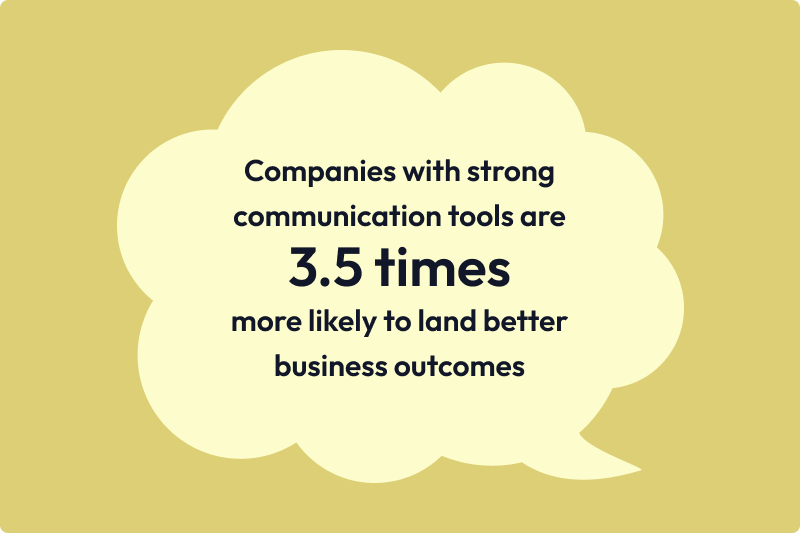
- Get internal communication right, and the payoff is real: companies with strong communication tools are 3.5 times more likely to land better business outcomes. (TeamStage)
- Among companies running digital signage for internal communication, 84% report a genuine bump in employee engagement. (Payline Data)
- Employees who feel genuinely well-informed about company changes are far happier in their jobs than those left in the dark (88% vs. 36%), and employees who hear from senior leadership on a weekly basis are nearly twice as happy as those who never do (77% vs. 41%). (Staffbase & YouGov, 2025 International Employee Communication Impact Study)
- When digital screens serve as an organization’s main crisis-communication channel, employees rank that experience above every other channel tested, ahead of newsletters, employee apps, and the intranet, with 72% giving it top marks. The catch: only 3–5% of employees currently get their crisis updates this way. (Staffbase & YouGov, 2025 International Employee Communication Impact Study)
Where the stakes are among the highest: manufacturing and the frontline
- Nearly two-thirds of manufacturing workers (63%) say leadership’s messages simply never reach them, and research links that silence directly to avoidable errors and safety incidents. (Microsoft WorkLab)
- More than three-quarters of employees (77%) call clear communication one of the most important parts of their day-to-day experience at work. (iFactory)
What digital signage statistics reveal
Taken together, these digital signage statistics tell a fairly simple story. The problem isn’t that companies have nothing to say, but they keep saying it through channels that don’t suffice on their own, at the wrong moment, and then act surprised when nobody heard it.
Relying on emails alone doesn’t work anymore
Email is a perfect example. It’s still the default, leaned on by 86% of organizations, and yet 6 to 7 out of every 10 employees miss important updates anyway. You could hire the best communication specialist in the world and it wouldn’t matter, because email was built for detailed, async communication, not for reaching everyone, everywhere, in the moment something changes. When attention lasts only a handful of seconds and nearly everything the brain takes in comes through the eyes, a paragraph competing with fifty other unread emails simply doesn’t stand a chance. It’s part of why a screen holds onto roughly four to five times more of a message than an inbox does: the format itself does work that no amount of clever email copy can undo.
This is exactly the gap always-on, visual channels like digital signage were built to close. A screen in a break room, a warehouse, or a shop floor doesn’t ask anyone to remember it exists, log in, or scroll past unrelated noise to find it. It’s just there, impossible to miss, easy to glance at, gone in the same few seconds people actually have to give it.
When people don’t receive the information they need, there are consequences
The cost of ignoring this isn’t abstract. Nearly a third of employees say leadership isn’t being consistent with them, barely 1 in 10 non-desk employees feel genuinely well-served by the communication they get, and most people already halfway out the door point to bad communication as part of why.
On the frontline and in manufacturing, the stakes climb higher still: when close to two-thirds of workers say leadership messages never reach them. That’s a safety and quality risk waiting to happen. It’s no coincidence that most employees, across every industry, rate clear communication as one of the most important parts of their day at work.
The solution is all about choosing the right communication channels
The upside is just as clear-cut. Companies with strong internal communication are several times more likely to report better business results, and the vast majority of organizations using digital signage for internal communication see engagement climb as a direct result.
The clearest illustration might be crisis communication: according to the 2025 International Employee Communication Impact Study by YouGov and Staffbase, employees who get their crisis updates through a screen rate that experience above every other channel available to them, newsletters, employee apps, and the intranet included. And yet screens are how only a tiny fraction of employees currently receive that information. It’s a channel that already beats everything else on the list, sitting almost entirely unused.
Across nearly every source, the same pattern holds: visual, always-on channels catch people that email, Slack, and intranets tend to miss, which is exactly why the two work best side by side.
And this isn’t just a numbers-on-a-slide kind of upside. It shows up in how people actually feel at work. Employees who feel well-informed about the changes happening around them are happier in their jobs by a wide margin. Zoom out to the business level and the same pattern holds: companies in the top tier for employee engagement post noticeably higher profitability and productivity than those at the bottom. None of this requires a moonshot. It requires getting the message to people in a way they’ll actually absorb, which is precisely the problem a well-placed screen is built to solve.
The next steps: what companies can do to improve their communication
The digital signage statistics above aren’t just interesting, they’re a checklist. Here’s where to start:
- Audit where information actually gets lost. Before adding new channels, map how a message travels today: who sends it, where it lives, and how many steps stand between it and the person who needs it. Most silos form at handoff points, not at the source.
- Reduce reliance on channels people have to open. Email and intranets aren’t going away, but they shouldn’t be the only channels for company-wide and/or time-sensitive information. Ambient, always-visible channels, such as digital signage in break rooms, production areas, and common spaces, catch the people that inbox-based communication consistently misses.
- Design for the attention span you actually have. With an average attention window of a few seconds, messages need to be visual first and textual second: a headline, an icon, a number, not a paragraph. This is especially critical for frontline and deskless employees who don’t sit near a screen by default.
- Close the loop with leadership specifically. Since unclear or inconsistent leadership communication is one of the most cited drivers of disengagement, make leadership visibility a deliberate design choice: recorded updates, recognizable faces, and consistent cadence, just to name a few.
- Prioritize safety- and operations-critical messaging first. If frontline and manufacturing teams are the group most likely to miss leadership communication, they should be first in line for a visual, always-on channel, not last.
Conclusion
The digital signage statistics tell the same story from every angle: internal communication mostly fails because the delivery method doesn’t match how people actually take in information: quickly, visually, and rarely with the time or patience to go hunting for it. Closing that gap doesn’t take a culture overhaul. It takes putting the right message on the right channel, somewhere people will actually see it without having to try. Digital signage won’t replace email, Slack, or your intranet, and it isn’t meant to. But it closes the exact gap those channels consistently leave open.
Want to talk to us and take the first step towards more effective communication? We’re here to help you. Reach out to us, let’s think it through together.
About the author



 Login